“Citizen Kane” in Virtual Reality: The Great Hall Recreated
The 1941 film “Citizen Kane” may have been originally filmed in Hollywood, California, but University of Michigan professor Matthew Solomon and Western Michigan professor Vincent Longo (PhD ’22, University of Michigan) decided to bring the movie’s iconic sets right here to the Duderstadt Center — in virtual reality. In their “VR Citizen Kane,” Solomon, Longo,…
The 1941 film “Citizen Kane” may have been originally filmed in Hollywood, California, but University of Michigan professor Matthew Solomon and Western Michigan professor Vincent Longo (PhD ’22, University of Michigan) decided to bring the movie’s iconic sets right here to the Duderstadt Center — in virtual reality.
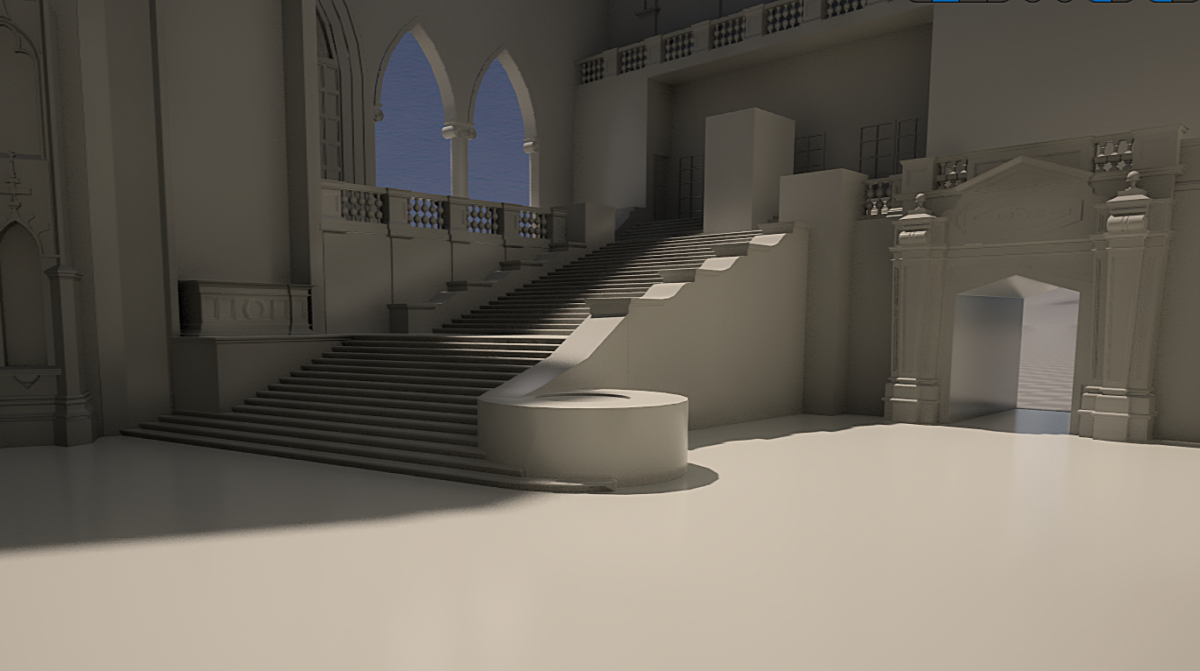
In their “VR Citizen Kane,” Solomon, Longo, and their team have worked for years to painstakingly recreate sets from the movie, like the staircase in the Great Hall, in a virtual reality setting. In doing so, they created a tool that allows all students to gain experience in directing by taking a seat in the director’s chair and recording an actual scene from the film in VR.
“It’s this teaching tool which allows infinite variations on a scene from a well-known film,” said professor Matthew Solomon. “To me, it’s an incredible teaching tool because I’m not asking students to think about how it might be different if the camera was in some other place. I can say, ‘Go try it out. Put it over there. Now you tell me what has changed.’”
The Great Hall scene is the second iteration of the “VR Citizen Kane” project, with the goal to have four complete scenes that students can use as a tool to practice different directing techniques. The first iteration of the project was the Rage Scene, which is currently available to all students on any computer within the Duderstadt Center.
“It’s loaded on all the computers at the Duderstadt Center, so you can go into the lab and request the person at the lab to log you into ‘VR Citizen Kane’, and you’re in and can play around with it as much as you want,” said Solomon. “Anybody could walk in and use it at any time the lab is open.”
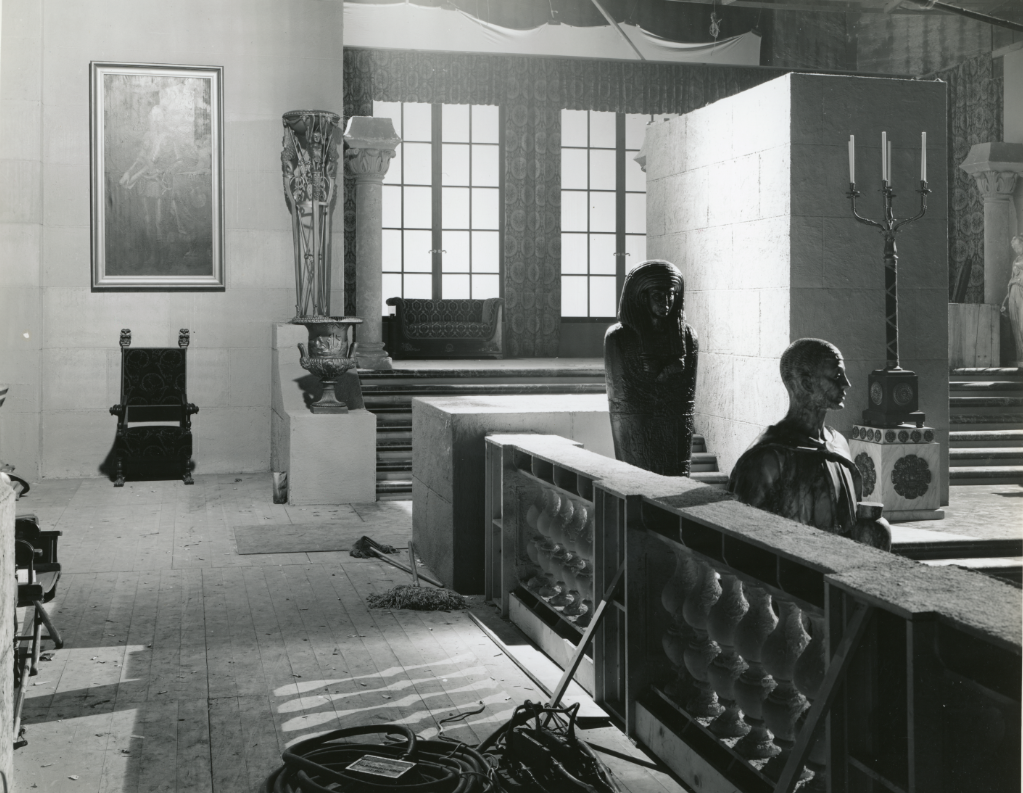
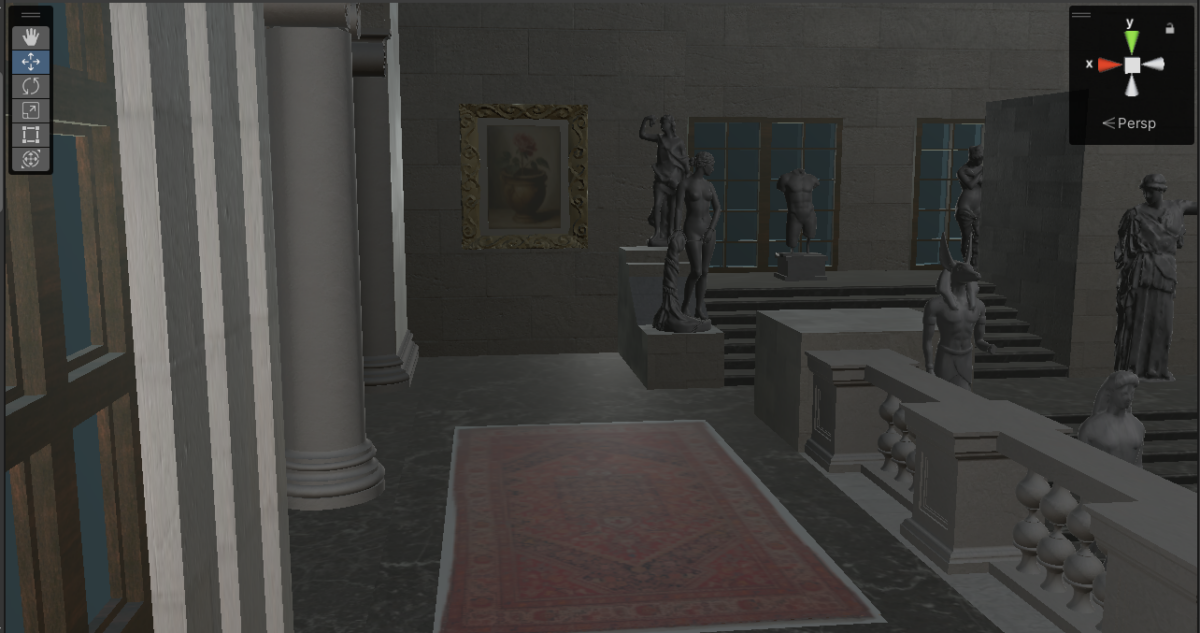
The upstairs continuity photo with the VR recreation.
When Solomon and Longo were looking for students to work on a new scene, they first met Hassan Berry. Taubman student Hassan Berry has been working on this project as a research associate since 2023. As a community college student at the time, Berry said he was looking for an open opportunity to conduct research through the Community College Summer Fellowship Program and was directed to “VR Citizen Kane.”
“I had 24 hours left to find a project, and [my coordinator] reached out to Dr. Vincent Longo, one of the mentors on the project, and he was like, ‘Hey, I have the student. He’s interested in architecture. He’s interested in VR stuff. He’s good at 3D modeling. He might be a good fit for the project,’” said Berry. “Then I interviewed with them, I loved the project, and the rest is history.”
To pick what would be the second VR created scene, Berry watched the 1941 film three times over. After his third screening, Berry settled on recreating the Great Hall.
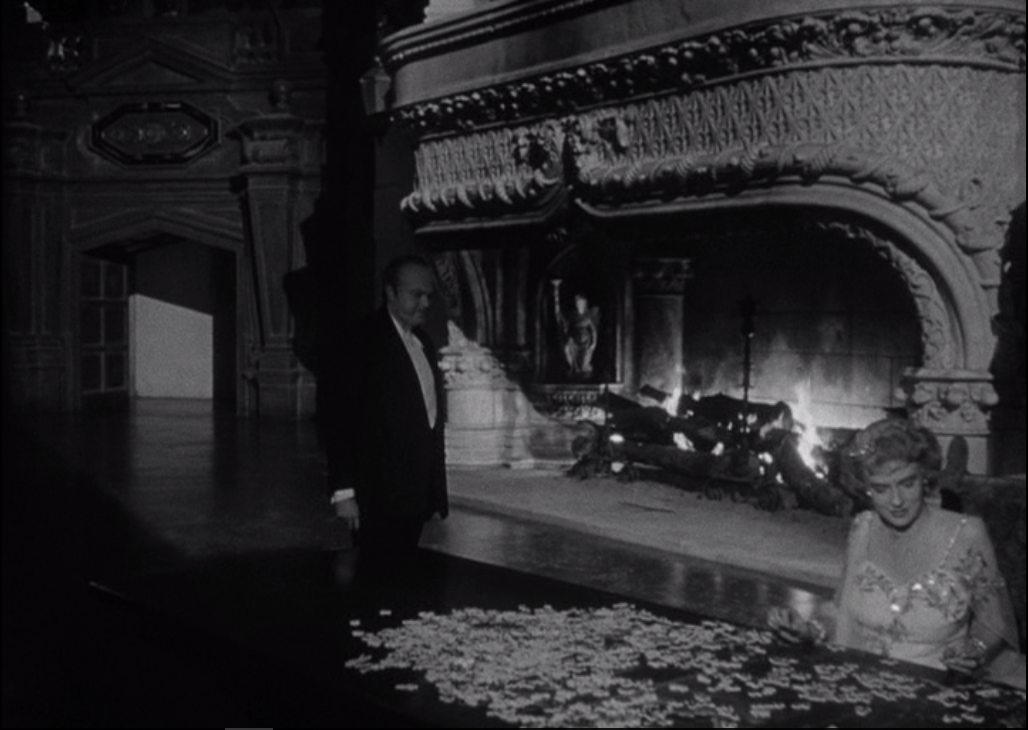
“I was reviewing the continuity photographs, and there was this one particular picture of the Great Hall stairs,” said Berry. “[When] I saw that picture, I was like, ‘Ooh, this looks pretty cool. It looks pretty easy to recreate. I think I could probably do it in a month or two.’ And so I go to [Longo], and I tell him I’m interested in this specific scene. And [Longo] goes, ‘Oh my God, you picked the Great Hall. This is the biggest, most ambitious film set in the entire movie.’”
The project was ambitious for sheer size alone. And after hearing how challenging Longo believed the project to be, Berry wanted to do the scene more than ever.
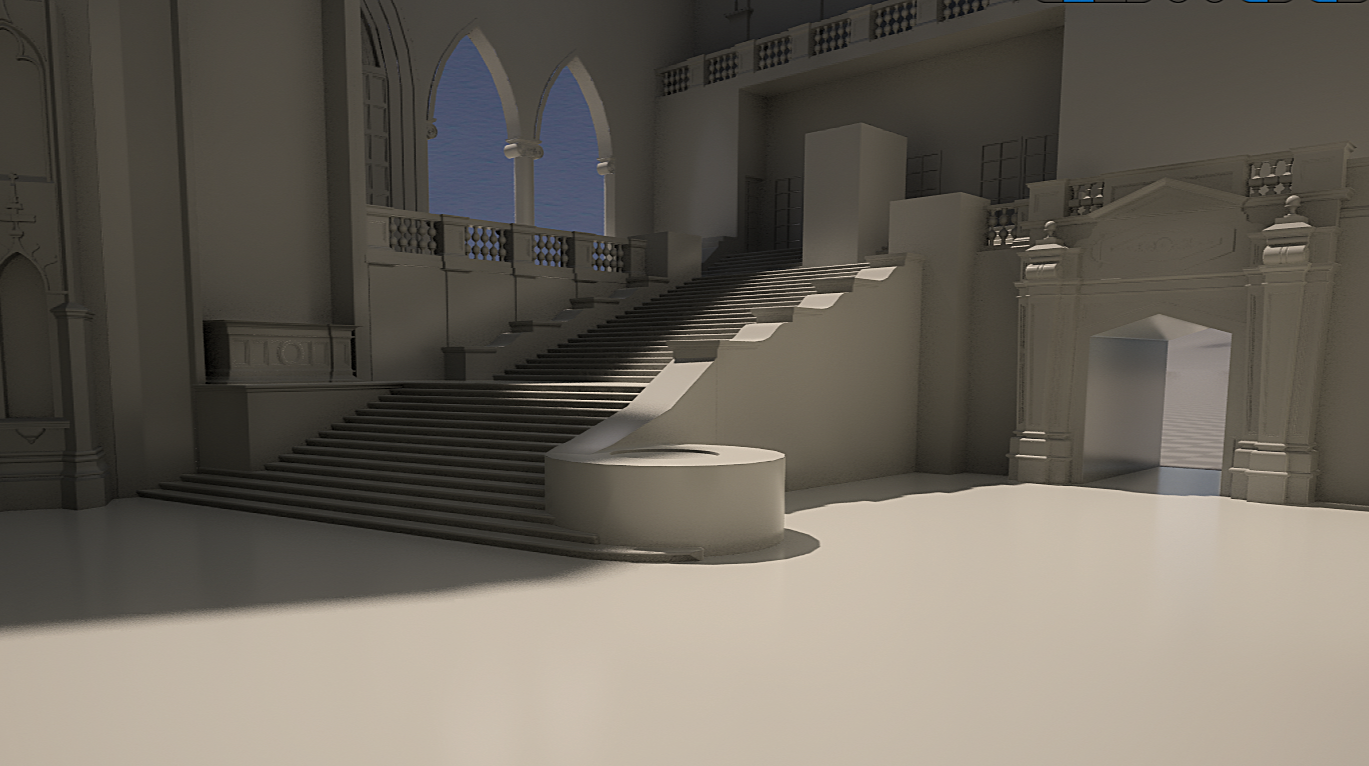
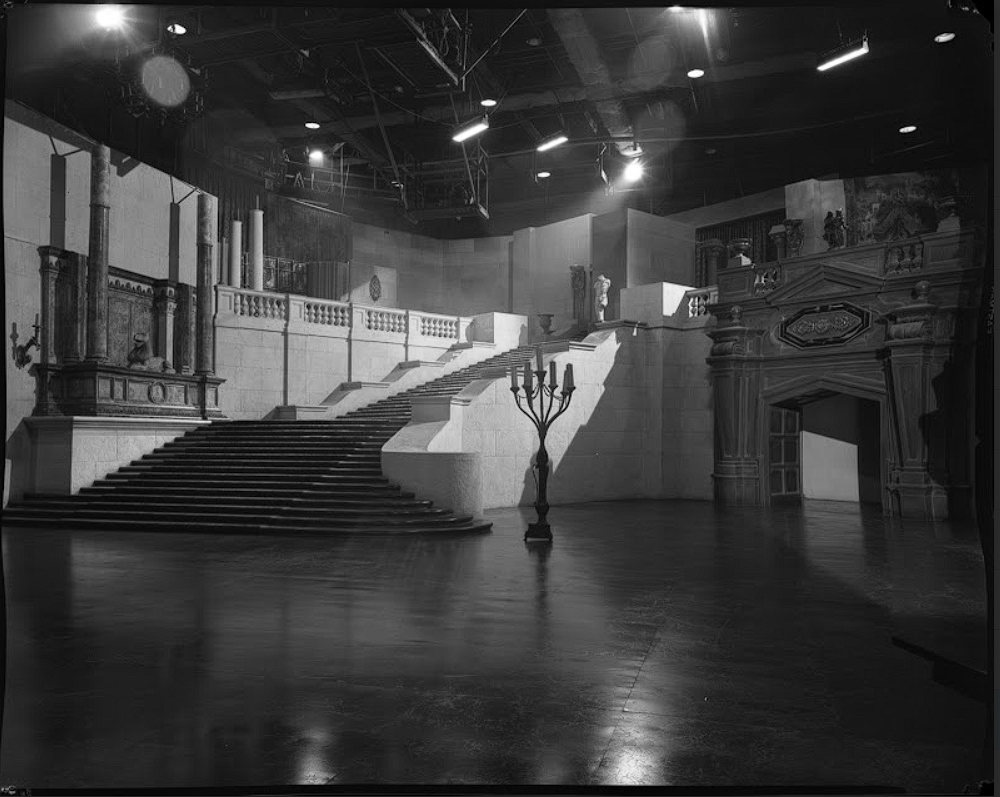
The Great Hall stairs continuity photo with the VR recreation.
“We’re usually pretty wary of VR projects,” said Sara “Dari” Eskandari, XR software developer in the Duderstadt Center’s Emerging Technologies Group (ETG). “We always want to make sure it’s a good use for VR, and it’s not just VR for VR sake. Something that was really interesting in this application was the ability to change the composition of a very famous scene.”
As a XR software developer for ETG, Eskandari works in the Duderstadt’s Visualization Studio. They help manage the lab and build applications for educational use, whether that’s in the classroom or for clinical trial research. In fact, their history with this project starts a few years ago, in 2019, when they started as a student employee.
“[As a student] I was brought on to do the initial pass of the user interface and some of just like the basic controls at that point, it hadn’t been used in the class before,” said Eskandari. “So this time around, instead of working on user interface implementation or new features, I got to guide [Berry] as he was 3D modeling this environment.”
They continue, “[Berry] just approached me initially for some 3D modeling assistance, and how it would be best to create the application for the game engine we were using. And then that morphed into a longer collaboration about virtual production. He’s been just a great mentee, an excellent student, and collaborator.”
As Berry was a part of the second iteration of the project, he was able to use the timeline and some work of the first edition. With the features of the camera dolly, the character selection, and the actual recording exporting features already configured, he was in the phase where he could start adding content. However, with an idea of how to go about the project based on the first edition, the freedom which Berry had to recreate the scene and his vision for it was pretty open, which surprised him.
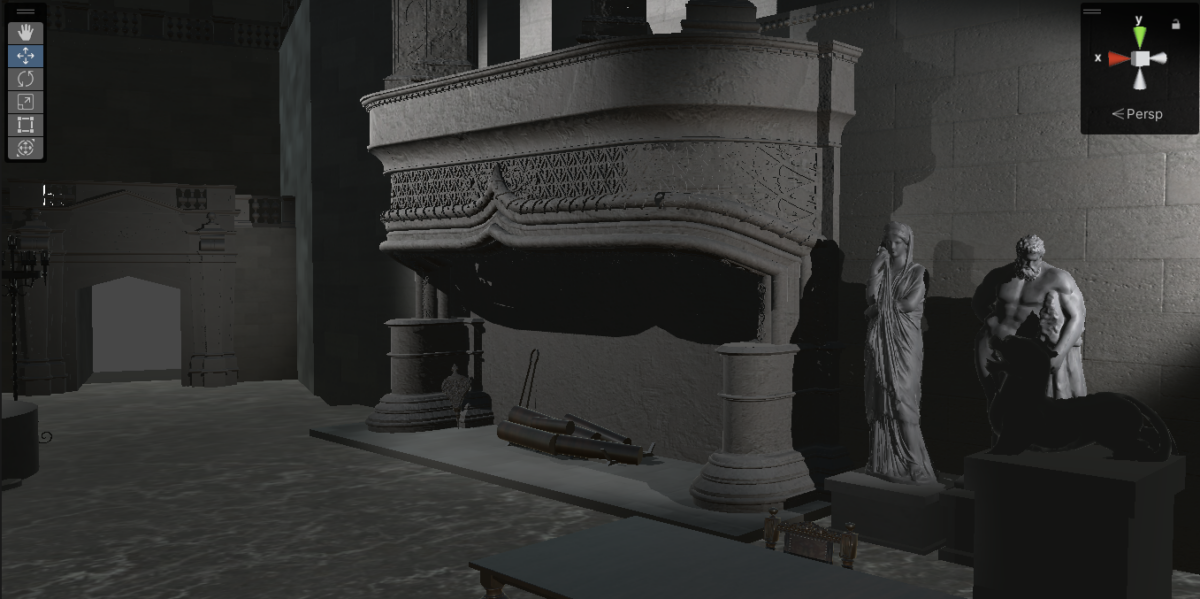
The fireplace set with the VR recreation.
“The original project was to just 3D model the film set,” said Berry. “And it was honestly pretty open in the beginning as well, which was surprising. I was coming from this background of, ‘Oh, we don’t trust undergrads to do anything, you have to be very specific,’ but Longo was very open in what we can do on the project. He was like, ‘Look, I really want this film set to be recreated. You’re the architecture student here. Go about this in the way that you see fit.’”
From there, Berry found himself working on many different aspects of the project, aspects he may not have initially considered.
“I’ve given several presentations [about the project] at this point, and there’s always these two halves to the presentation,” said Berry. “I have this one half of the presentation, which is the architectural development side, and that side I was expecting, right? It was drawing, reviews, critiques, redrawing and then modeling. But then there’s this entire side that I did not expect to take away, which is the game development side of it all: going in and learning about texturing, or learning about what it means to work with motion capture data.”
With all the aspects to this project, a key takeaway for Berry was learning about efficiency.
“My biggest takeaway is being mindful of efficiency,” said Berry. “The ways that we can create technological systems that are as efficient as possible, but still artistically get our point across, is something that I just was not familiar with. There is this whole world of optimization that you don’t really think about as an artist, or as a creator.”
A look through the director’s lens in VR
Though while learning about efficiency, Berry also learned something else from this project: a passion for getting this technology into the hands of as many people as he can.
“The whole notion of this technology is amazing, but it’s limited to people that could afford to go here,” said Berry. “And so, how do we get this out to as many people as possible and give this to the film student that’s not even a student, right? Just someone that’s interested in film and they want to try this tool? The goal is that you can do it anywhere, at any time, regardless of if you’re in high school or if you’re 45 years old in your basement with a VR headset on and you want to just become Orson Welles for a split second. This tool gives you that chance, regardless of who or where you are in the world.”
This realization of the power of technology spurred another ideation for Berry: his goal to become a teacher.
“And this is actually also why I want to be a professor,” said Berry. “[Professor Solomon] has given me the opportunity to work with his FTVM 307 (Film Analysis for Filmmakers) class and show them my process and create assignments based on my research, just a little taste of what I could be doing as a teacher. And I’m hooked. I’m like, holy moly, this is so exciting.”
“He took a [more] active role last semester,” said Solomon. “There was a 3D printing component that [Berry] was instrumental in bringing to the class. He spoke to students about his modeling and his experiences on the project. He was a good fit for the project because of what we were hoping to achieve, but needing the right person to do it. And Hassan clearly was that person.”
Currently, Berry is not just working on the Great Hall scene or teaching it to students, but is also working on the Cabin Scene from the film. As one thing wraps up, another begins for the “Citizen Kane” project.
“Virtual reality systems as a whole are a film project,” said Berry. “It’s a tool, obviously, for film students that don’t have access to the film set or the characters. And so it’s basically like being a producer or director in a box. Initially, I joined the project from this architectural standpoint, but over the years, it’s become this almost pedagogical awakening of introducing me to the world of teaching. And so, yes, I’m an architecture student, but I think above all else, I’m a student that’s aspiring to be a teacher because of this project.”