
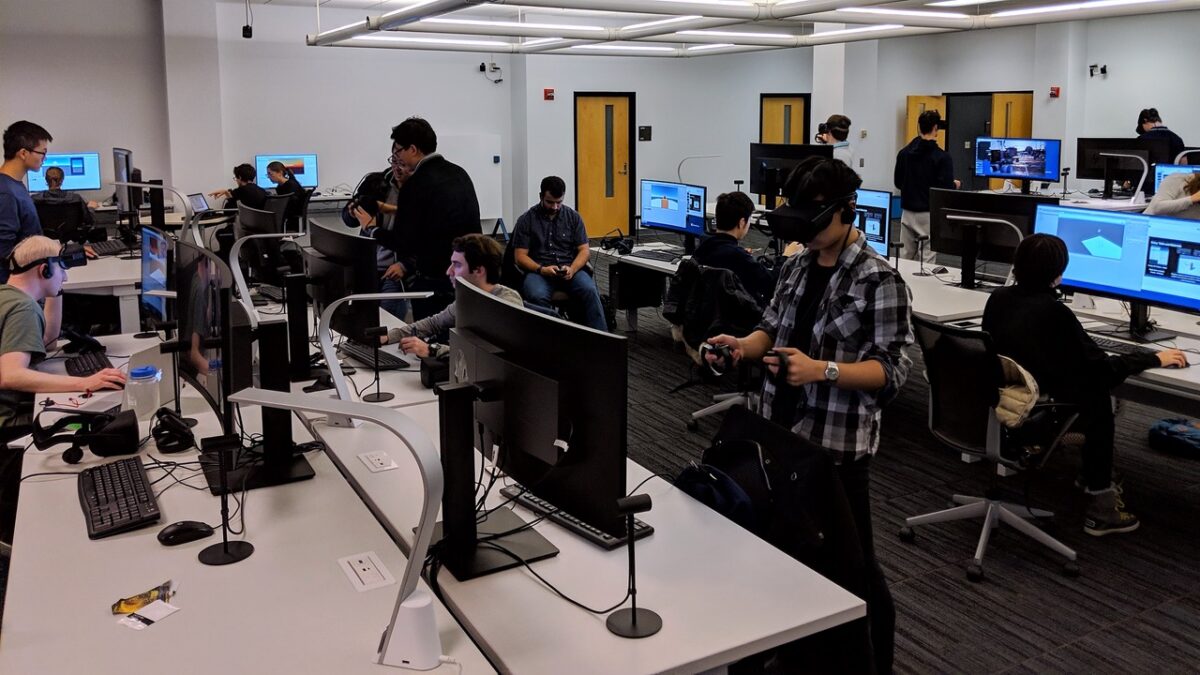
Over its thirty years of existence, the Duderstadt Center has created a space where state-of-the-art technology meets student, faculty, and staff creativity. Couple Yuqing Melanie Wu, a 2004 College of Engineering Ph.D. graduate, and Qiang Lin, a 2001 College of Engineering Masters graduate, recall their experience with the Duderstadt Center’s technology when it was less than a decade old.
“Our experiences were similar to many other international graduate students of the College of Engineering about 20 years ago: amazed by the brilliant faculty and cutting edge facilities,” they said. “Personally we were impressed by the large number of the Sun Solaris Unix workstations available particularly at the Duderstadt Center, where two or three of those Unix workstations were arranged in a single cube to facilitate group course projects. Each workstation would cost a small fortune in the eyes of international students like us.”
They continued, “At that time, as some important engineering software could only be installed on the Unix platforms, we got chances to learn about the latest technologies, which we deeply appreciated. Hopefully our small contribution could give current students access to state-of-the-art hardware and software, just as we had the opportunity decades ago.”
With their support, the Duderstadt Center’s Visualization Studio will now be equipped with a portable teaching station and six new VR capable workstations, each equipped with MetaQuest 3 VR headsets, and Huion Drawing Tablets. These new stations help fill the need of classes– both large and small– that use the Studio in the Duderstadt Center. The new stations also help address an equity issue on campus: the replacing of graphic-intensive campus labs due to an expectation that students can simply rely on their personal devices to complete coursework. The hope is that, just like in the days of the now-outdated Unix workstations, students will have a place to combine their studies with the technology of tomorrow.