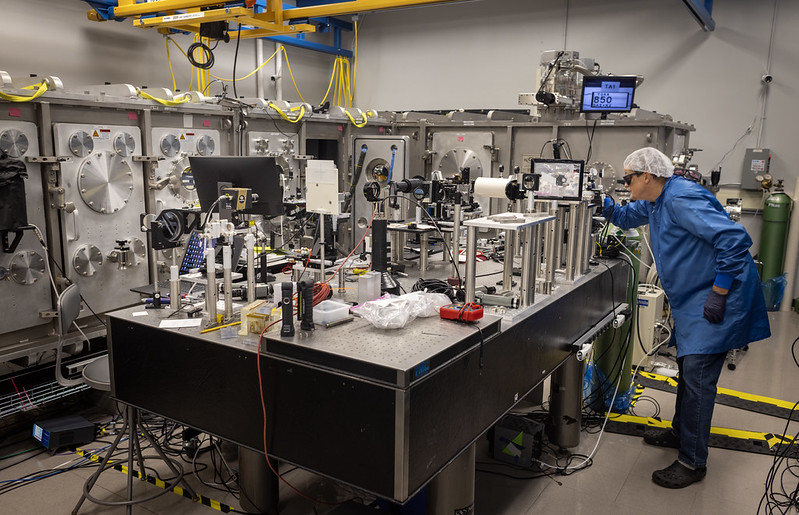
Powerful Fusion Pro at Work: Supporting the ZEUS Laser
In the basement of the Duderstadt Center lies a hidden gem, tucked away from the bustling upper levels: the Fabrication Underground. The facility boasts a number of free resources to help University of Michigan students, faculty, and staff create prototypes using industry-standard 3-D printers, sharpen their woodworking skills at the Woodshop, or fix a bike…
In the basement of the Duderstadt Center lies a hidden gem, tucked away from the bustling upper levels: the Fabrication Underground.
The facility boasts a number of free resources to help University of Michigan students, faculty, and staff create prototypes using industry-standard 3-D printers, sharpen their woodworking skills at the Woodshop, or fix a bike at the Bike Repair Station. Among these many resources, Fabrication Underground is also home to the Fusion Pro, a laser cutter that can cut acrylic and laser-safe wood materials.
Among the projects the U-M community has used the Fusion Pro for, there is one project that is quite powerful. Richard Anthony is a Laboratory Engineer at the NSF ZEUS (Zettawatt-Equivalent Ultrashort pulse laser System) User Facility at U-M, a 16,000 square-foot facility on North Campus that houses a laser and beam delivery system which recently achieved 2 petawatts of power — making ZEUS the most powerful laser in the country.
Anthony has been visiting Fabrication Underground to use the Fusion Pro to help create parts that would aid researchers and engineers in their usage of the ZEUS facility laser. For example, Anthony made cradles to use as baffles, which are materials that prevent gas or light from disrupting the direction of the laser.
“There are these cradles that we use for baffling because we’re having issues with the air currents disturbing the laser and the way it’s pointing,” Anthony said. “So we put these pieces of acrylic that we pieced together into these half-moon-shaped cradles, which stabilize these long, plastic tubes where the laser is traveling down the center of.”
In addition to making the cradles, Anthony has used the Fusion Pro to cut acrylic pieces for a box that is placed around a small piece of equipment called the Femto Pro for safety precautions. The Femto Pro is an oscillator — a machine that creates repetitive oscillating signals — and acts as a backup “clock” to measure the time it takes for a pulse of light to travel between mirrors.
Laser-cut acrylic pieces used to assemble the box surrounding the Femto Pro
John Nees, an Electrical Engineering and Computer Science research scientist and ZEUS co-investigator, said the current box is acting as a prototype but still provides the necessary protection while allowing for researchers to see how the green light of the laser scatters.
“The box acts as a protective layer but we would still have to wear safety goggles around it,” Nees said. “But having a transparent cover, or at least one that is colored, makes it possible for us to look at the laser as it’s operating and see where the spots are. Since we can’t see it [with the naked eye], we use our cell phone camera and occasionally we’ll use another device called an IR Viewer.”
The acrylic pieces assembled into the box
As an NSF user facility, ZEUS provides experimental access to external users, serving researchers in the U.S. and abroad. From experiments ranging from semiconductor research to neutron generation, the opportunities to push research further at ZEUS are endless and Fabrication Underground is helping it do so.
To learn more about Fabrication Underground, contact the team at [email protected] and check out the website here. To learn more about the NSF ZEUS User Facility, take a look at their website here.
Photo Credits: Eilene Koo; Marcin Szczepanski, Lead Multimedia Producer, University of Michigan College of Engineering.