
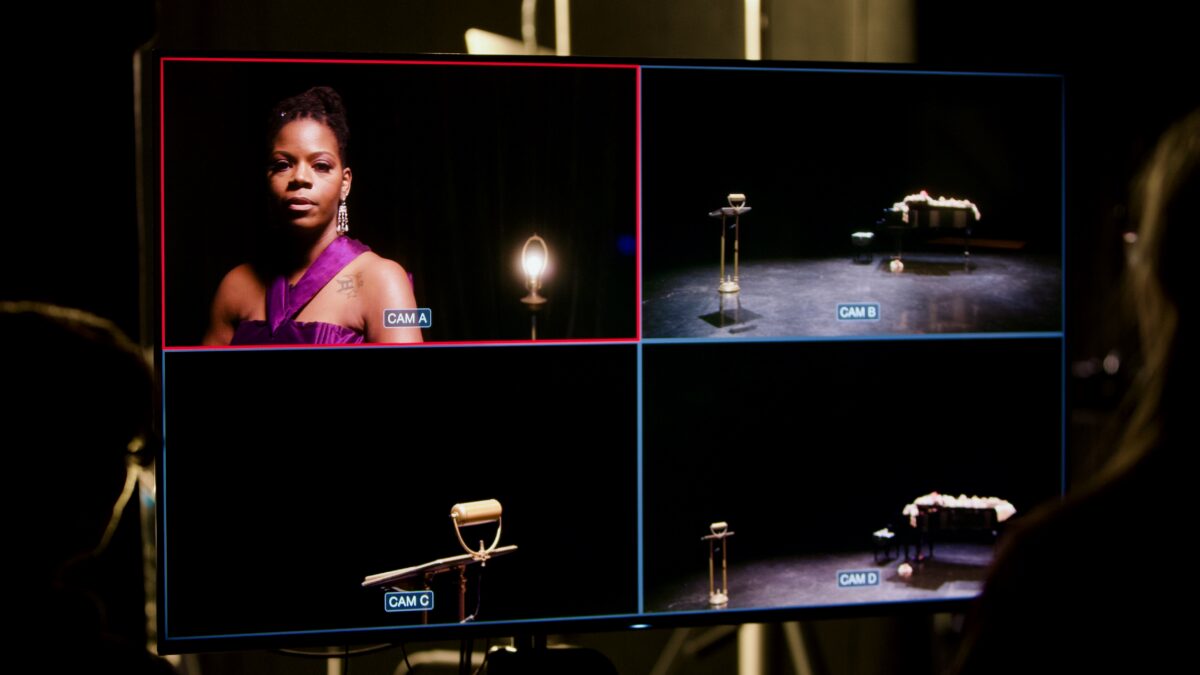
Over this past summer, senior Coltrane Gilman helped edit How Do We Begin, a drama film rooted in fact that uncovers the University’s historical prejudices. CRLT Players, or for the Center for Research on Learning and Teaching, were the creative visionaries, taking cues from the stage play, How Do We Begin: A Historical Reckoning with Anti-Black Racism at U-M by Jordan Harris, which was originally inspired by Matthew Johnson’s Undermining Racial Justice: How One University Embraced Inclusion and Inequality.
Gilman, a University of Michigan Performing Arts Technology senior, worked on this project for his job as the Lead Video Editor in the Duderstadt Center Video Studio. Though this project was initially created for the University’s instructional community, he hopes that the whole University will support its message.
“I really stand by this project,” said Gilman. “I thought it was really inspiring in many ways. I hope that the University in a broad sense wants to own this video and really put their foot behind it.”
And while supporting the gravity of the film’s message, Gilman was also vital to the success of the project. In fact, he was commended for his exemplary work as the post-production editor for this project.
“When we approached Coltrane to do the project, we were hopeful he’d be interested,” said Catherine Miller, the Co-Cinematographer, Post Production Supervisor, and Assistant Manager of the Duderstadt Center Video Studio. “We had full faith in his abilities and knew he would be more than capable of handling such a large project.”
Gilman says that though he has been working in the Video Studio since the beginning of his sophomore year, this is his biggest project to date.
“Once we were in the flow of doing it, I realized, ‘wow, this is a much higher budget operation,’” Gilman said. “I mean, even down to the costume design, the set design, the acting. Everything was a cut above what we’ve usually been doing.”
The total run time of the film is 49:02, and Gilman worked on the project beginning in the summer of 2025, with the final cut happening in the tail end of the Winter semester. Miller had nothing but praise for what Gilman could accomplish.
“The final runtime is 49:02, and we had a pretty tight turnaround, especially given our limited staffing,” said Miller. “Coltrane tackled the challenge beautifully and consistently delivered exceptional work on schedule throughout the entire process.”
Gilman talked about how this project was also gratifying in many ways. It was a substantial shift from what he was used to, and it gave him experience in cutting something new.
“A lot of what I do at the Video Studio is more movement-based and theater-based music videos, with a lot of dance,” Gilman said. “That’s really fun to edit, but I haven’t had as many opportunities to edit narrative work, kind of slower work, like dialogue and talking.”
How Do We Begin as a project was also a tonal shift from the usual work done within the Video Studio. It balances serious topics of prejudice with lighter, satirical moments.

“It was a really cool opportunity to be able to edit something narrative that was substantial: something that’s not only comedic, [as] I’m a huge fan of comedy, but also [has] a very serious political overtone,” said Gilman. “I enjoyed having a bit of seriousness, and having it be narrative; and also just the production value of the whole thing, I thought, was really inspiring.”
All-in-all, Gilman had nothing but love for the project, the people, and what he is able to work on.
“I just highly recommend every freshman and anybody interested in doing production to get a job here. You can learn stuff all day, but the best stuff is just coming in, doing the work, and learning it with really talented and qualified people like Catherine and Patterson, Matt and Jim, who have been doing this for so long and really know what they’re doing,” said Gilman. “This has really built my understanding for production and post-production and also my love for it, and it’s really informed my future.”

Finally, you can find more information about Coltrane Gilman and his work through his portfolio website, which stays up-to-date with each of his most recent projects.
Photo Credits: Courtesy of Duderstadt Center Video Studio
Article by Emma Powell