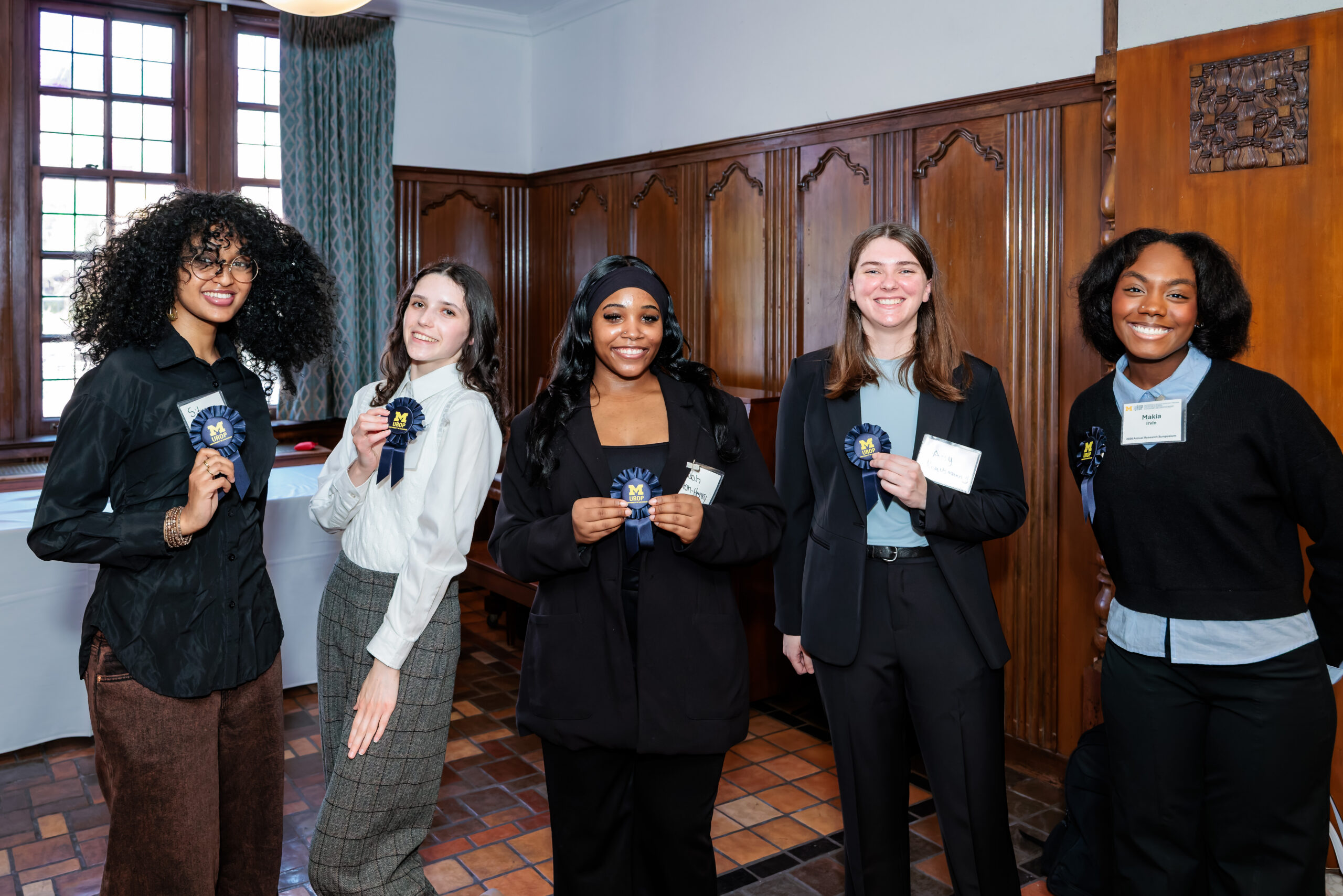
Congratulations to the student researchers of Visioning Black Performers in a Lost Film, Sanáah Alston-Henry, Penelope Clark, Makia Irvin, Amy Krausmann, and Sityena Muzeyen, for receiving UROP Blue Ribbon awards of excellence for their outstanding research in creative projects at the 2026 UROP (Undergraduate Research Opportunity Program) symposium. While greatly leveraging the Duderstadt Center’s resources, the Visioning Black Performers in a Lost Film team “shed light on the lost histories of marginalized communities and their contributions to The Big City (1928),” a lost film of which no versions still exist.
The Big City was notable for the critical mass of Black performers who appeared in the cabaret scenes of the film, all of whom were uncredited. See Prof. Solomon’s Video for more on the project. Visioning Black Performers embraces lost histories as opportunities for historical reparations delivered in an empathetic, “edu-tainment” environment, through collaboration with the Arts Initiative, formerly ArtsEngine, FEAST program. Student researchers led by Professor Matthew Solomon worked in partnership with the The Big City: Lost and Found in XR development team, led by Duderstadt Center XR Software Developer, Sara “Dari” Eskandari, at the Visualization Studio.
The FEAST Developers featured at the 2026 UROP symposium included Hannah Kim, M.A., who designed, programmed, and quality tested the Just Dance! style minigame within the VR application, in which dance researcher Makia Irvin coaches the player on how to perform the Black Bottom Stomp, featured in the film. Specificity in reclamation is key, so Makia’s likeness was captured and preserved by FEAST developers Alef Liu and Jingmin Mei, who photogrammetry scanned her for Unreal Engine metahuman creation at the Visualization Studio. In addition to researching the lost steps of the Black Bottom Stomp, a variation on the Charleston, Makia assembled references of dance icon, Josephine Baker, for her metahuman styling. Donning a dotted motion capture suit, Makia performed a modern interpretation of the Black Bottom Stomp in the Visualization Studio motion capture studio – operated by Steffen Heise – for animation and implementation in Hannah’s feature dance game. At the 2026 UROP Symposium, audience members were able to play the minigame to learn the Black Bottom Stomp steps, and perform at the Virtual Reality Black Bottom Cabaret, using a portable Meta Quest Pro headset provided by The Visualization Studio.
Interdisciplinary UROP/FEAST Research collaborations included Sanáah’s research following the trail of uncredited Black actors through major Black historical newspapers like The Pittsburgh Courier, which became “lost and found” collectible items in the VR Cabaret Gallery which were written by FEAST team Cornelia Ovren, and Professor Solomon, accompanied by a 3D model created by Nicole Salinas.
Amy Krausmann analyzed the atmospheric intimacy of Black cabaret spaces in the film and in historical Black communities. As part of the process, Amy examined surviving production stills taken during the making of the film to faithfully reconstruct the setting, which includes a full view of the fictional Harlem Black Bottom Cabaret that improved the accuracy of previous renditions. Amy’s blueprint was the direct reference for Celine Darvas to 3D model a new interior. In the summer, with the support of a UROP Summer Undergraduate Research Discovery Grant, Amy will work with Dari and the Visualization Studio to learn more about visual effects and volumetric video to explore possibilities for approximating the social intimacy of historical Black spaces in virtual reality.
Finally, Sityena Muzeyen’s compiled documentation analysis became the primary reference material for Alef Liu, who 3D modeled the exterior buildings in Blender and arranged and textured them in Unreal Engine. Sityena’s eyes for vibes, Alef’s 3D practical skills, and their regular collaboration generated an exterior replica. Sityena also served alongside Cornelia Ovren as a unique liaison between the FEAST and UROP teams, as inter-project collaboration across courses compounds scheduling challenges.
Professor Solomon and Developer Dari first collaborated on Citizen Kane VR at the DMC Emerging Technologies Group’s Visualization Studio in 2019, and formalized the development process into a FEAST opportunity in 2023 to generate collaboration opportunities for young game developers, and create a meaningful, educational virtual reality simulation game. This immersive research outcome and client-developer pairing vaulted Visioning Black Performers in a Lost Film to the upper echelon, winning the Blue Ribbon spotlight first in 2025, and again this year. Last year, UROP researcher Hassan Berry was also awarded a Blue Ribbon for his expansion of Matthew Solomon, Vincent Longo, and the Visualization Studio’s Citizen Kane VR. The Duderstadt Center facilitates interdisciplinary project team collaboration, research, and results.
W 2026 Contributors
Principal Researcher, UROP Instructor
Professor Matthew Solomon
Development Lead, FEAST Instructor
Sara “Dari” Eskandari
Researchers
Sanáah Alston-Henry
Penelope Clark
Makia Irvin
Amy Krausmann
Sityena Muzeyen
Programmers & Game Developers
Andy Yao
Jingmin Mei
Jiali Zheng
Hannah Kim
Nicole Salinas
Junhao Lan
UI/UX Designers & Developers
Hannah Kim
Nicole Salinas
Jiali Zheng
Jingmin Mei
Junhao Lan
Interior Level Design & Prop 3D Modeling
Nicole Salinas
Hannah Kim
Celine Darvas
Alef Liu
Exterior Environment 3D Modeling, VFX, & Photogrammetry
Alef Liu
2D Texture Painting
Hannah Kim
Nicole Salinas
2D Design, Research Liaison
Cornelia Ovren
2D Design, Webmaster
Sing Ee Dodee Ong
Community partners/consultants
Raymond Nat Turner
Zigi Lowenberg
UpSurge Jazz