Whether it is Ohio’s own Cedar Point or the larger-than-life Walt Disney World in Florida, there are places that immerse park-goers into a world of unforgettable experiences. One of the key aspects of these theme parks are their physical sets, whether it is a jungle or a fantasy village. For his capstone, recent Taubman master’s…
Whether it is Ohio’s own Cedar Point or the larger-than-life Walt Disney World in Florida, there are places that immerse park-goers into a world of unforgettable experiences. One of the key aspects of these theme parks are their physical sets, whether it is a jungle or a fantasy village. For his capstone, recent Taubman master’s graduate Philip Vernon used 3D printing to recreate familiar environments, like those seen on the silver screen, for these captivating places.
Today 3D printing is becoming more essential to theme parks, and can be found in many different places, from 3D-printed toys for animals in Disney World’s Animal Kingdom to individual parts in rides. However, when trying to use 3D printing at scale, Vernon ran into a challenge:
“A designer may be hesitant to use 3D printing because they don’t know what is going to come out on the other side, and there aren’t the communication tools to be able to specify it, if they don’t have hands-on experience,” Vernon said. “In large projects, the digital designer and the person printing are almost never the same person. So, they need a way to talk to each other.”
Following these experiences, Vernon focused on bridging this “communication gap” by crafting a set of tools — calibration wedges and texture swatches — using the 3D printers in Fabrication Underground at the Duderstadt Center.
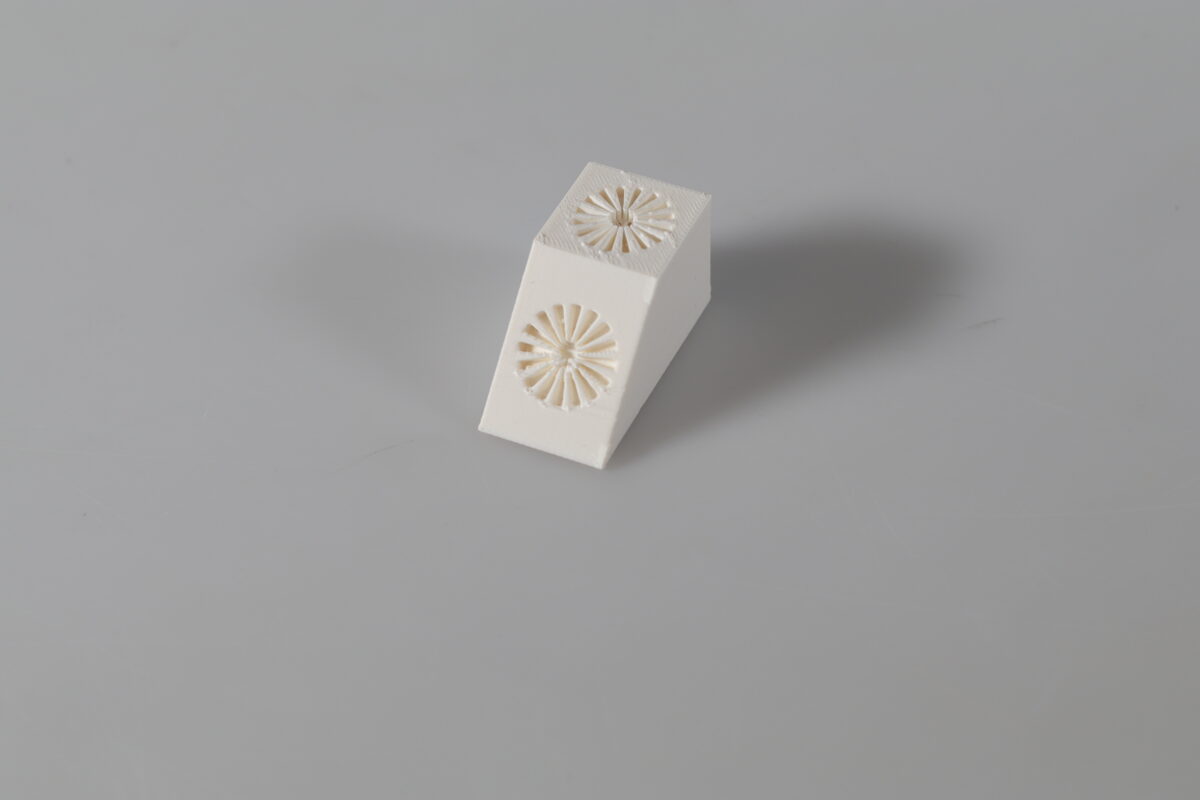
Calibration wedges are objects with a design familiar to those who have needed to test ink printer resolutions: a Siemens star. This sunburst pattern is a tool used to assess the resolution of camera lenses and printers. The point where the lines look to converge shows how precise the resolution is. Vernon decided to see if he could apply it to 3D-printed objects, too.
Calibration Wedge
“It felt like you could import standards from graphics into 3D printing; and there are ways [like the Siemens star] to measure resolution that already exist that you just have to apply to the printing,” Vernon said. “It’s the same exact thing, but just in three dimensions. Having access to Fabrication Underground’s range of 3D printers made it possible to check the resolution across multiple cutting edge machines.”
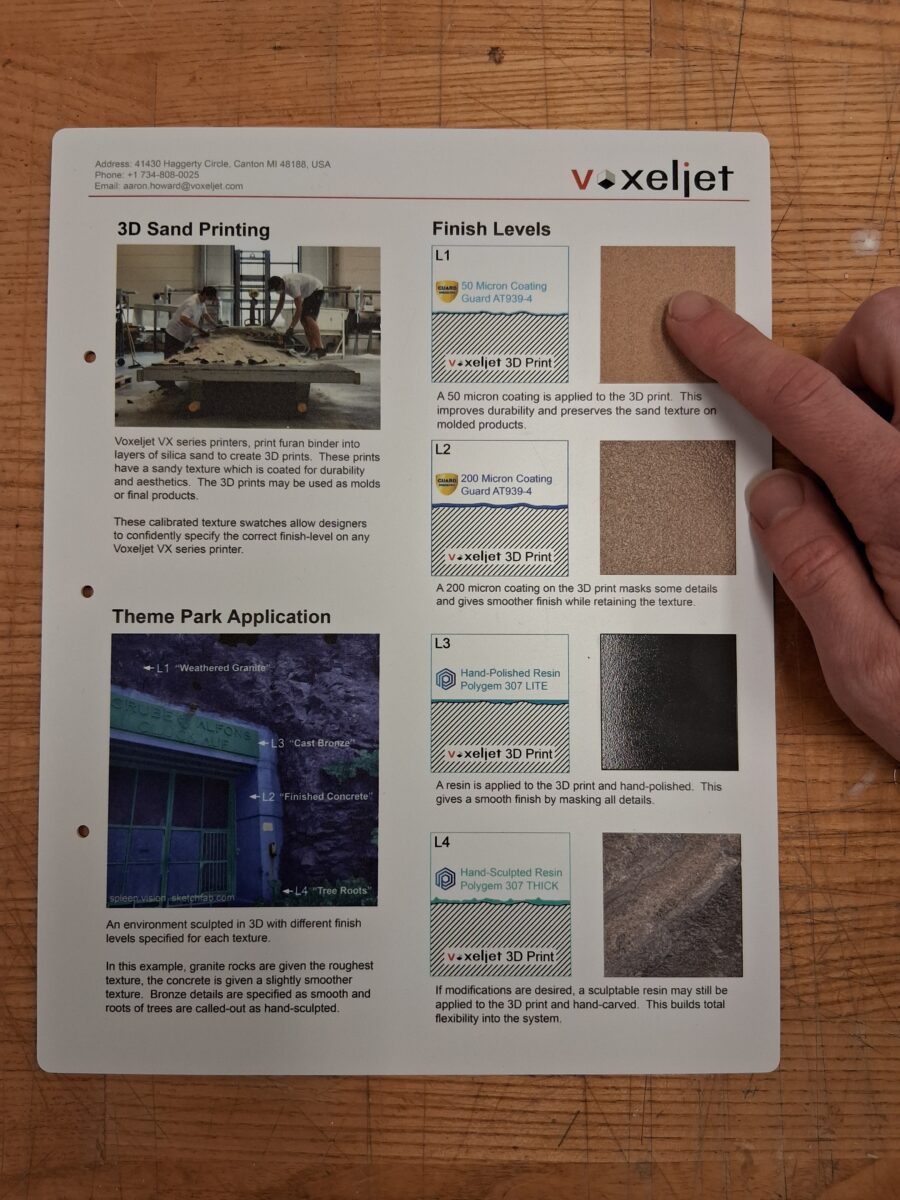
The second tool Vernon created is something he calls “texture swatches.” Much like its name, a swatch is a small square which replicates the texture of a 3D print for people to see and feel for themselves. Vernon used a third-party voxelijet sand 3D printer (a form of 3D printing that uses sand to cast the mold of the print) to create the swatch.
“In the way that you specify a color from a paint deck, you could specify a texture using a swatch because you’re able to feel the resolution coming off the machine,” Vernon said. “[This is] trying to communicate these kinds of textures to designers because so much of artistry is digital at this point. Think of making something out of a movie that is done totally in CGI. The technology exists to physically make this today, but there is still a communication gap.”
Texture Swatch
Similar to the texture swatches, Vernon created a third experiment of printing flexible textures, again which he created with the help of Fabrication Underground. These are flexible 3D printed molds of the desired texture, printed on the Duderstadt’s J850 printer. This printer was essential to Vernon’s project as it has the ability to print in different flexibilities and durometers. With the print being flexible, it is easy to demold and can be reused multiple times rather than breaking on each piece.
“Just the way that you would texture a virtual environment, flexible 3D printing allows you to texture a physical environment,” Vernon said. “So you can literally go from the same kind of textures that are used in gaming to produce the physical place. And because it’s flexible, you can make all sorts of shapes out of the same print.”
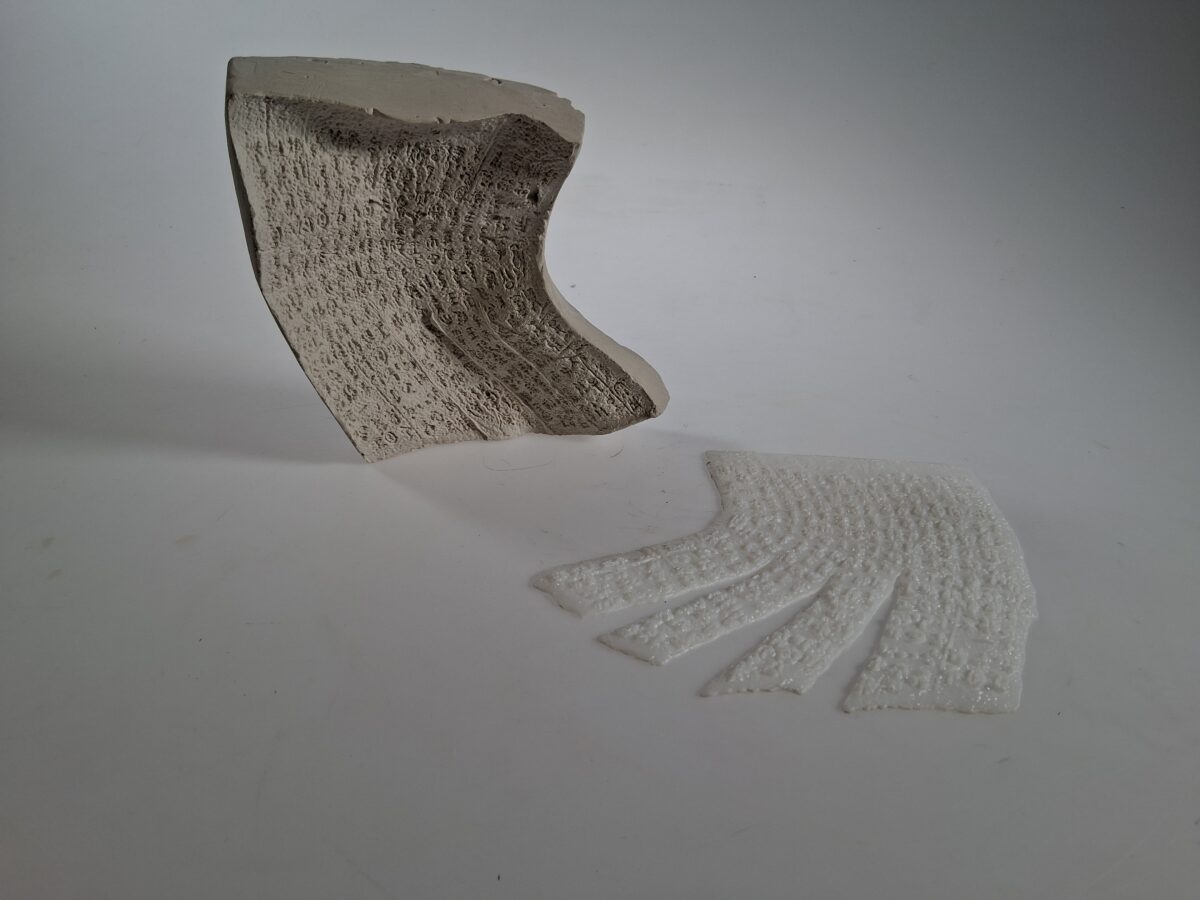
From this 3D mold technology, a variety of projects can be made. For example, Vernon recreated the side of a cauldron from the Ming dynasty, located in the National Palace Museum in Taiwan.
“There’s a long tradition of making ink rubbings from the inscriptions on the inside of the cauldron,” Vernon said. “So, just the way that you’d see a map with similar slits, you have to unroll the surface to flat to be able to pick up the texture. So this was another technique very similar to what computer games are using, but with hundreds of years of cultural history.”
3D Printed Cauldron
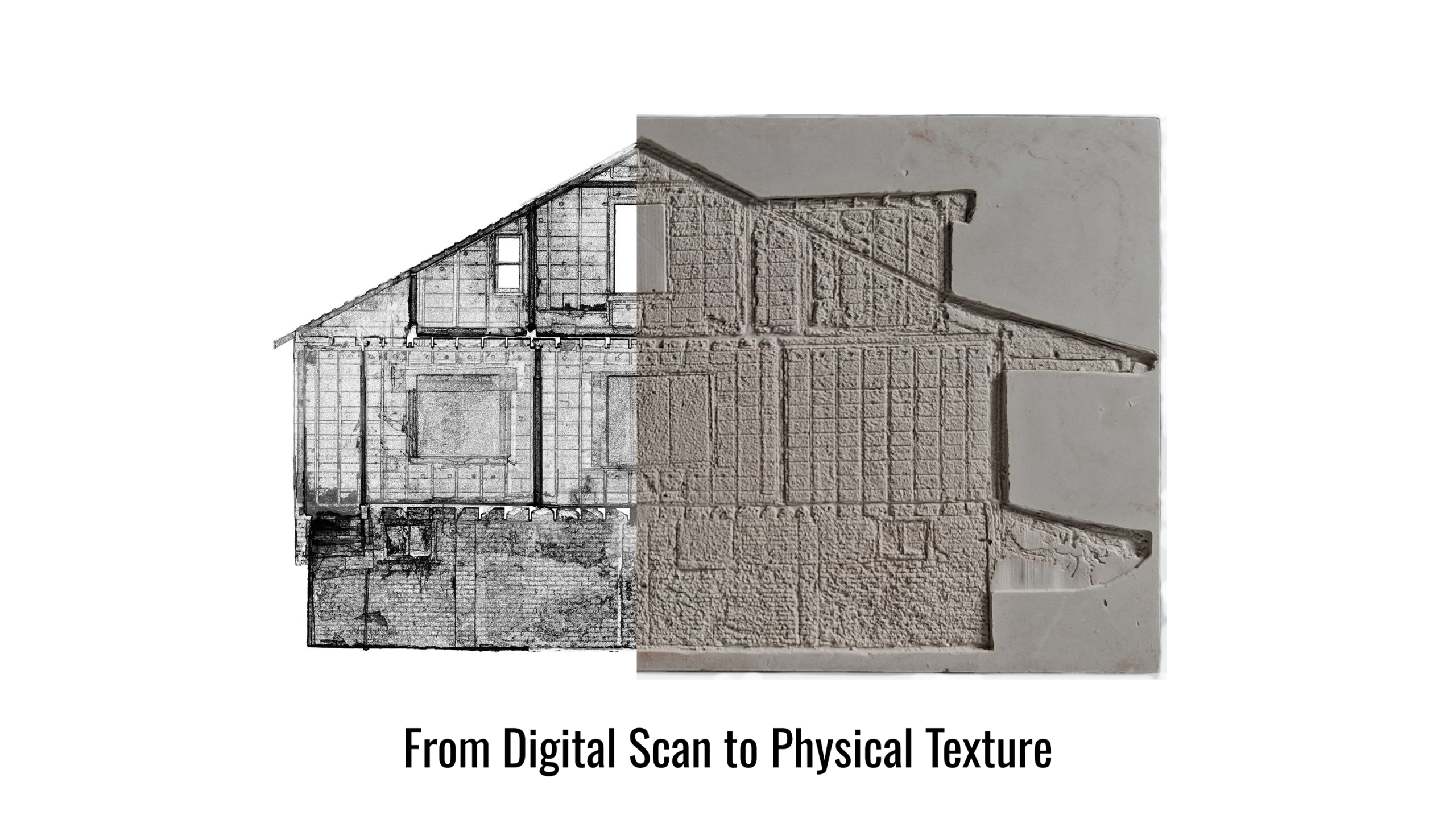
With these molds, Vernon also worked with Musheim Design Fellow Tess Clancy to print detailed molds from LiDAR scans Clancy had made of a Detroit home scheduled for demolition. Finally, Vernon showed that these molds can be used for artistic purposes, after creating a texture height-map from an untitled artwork by German painter Gerhard Richter.
With these new experiments, Vernon hopes to have created a useful tool for many, including architects, preservationists, game developers, and theme park designers.
“So [plaster castings] relate to all these different things, actually, even though it’s interdisciplinary potential,” Vernon said. “Even with the great support from the architecture school I wouldn’t have been able to do this on the 3D printers in Taubman’s FabLab, because their machines don’t print these flexible materials.”
Overall, Vernon is thankful for the help of the Duderstadt Center and the resources it provides.
“It’s important to have interdisciplinary labs like [those at the Duderstadt] because that’s where these kinds of things can happen,” said Vernon. “The 3D printers here are used in biotechnology, dentistry, and engineering, and Kathie Ferguson and the staff really facilitate innovation. But hopefully, coming from an architecture background with an interest in the cultural side of technology, [I can help] bring something new to the Duderstadt that opens doors for people working in other disciplines”
Photo Credits: Duderstadt Center Fabrication Underground