

After eight hours of scanning the Matthaei Botanical Gardens, Architecture student Jared Jenkins took a week to edit and render his data to fit into the Michigan Immersive Digital Experience Nexus, or MIDEN, housed in the Duderstadt Center. Now, he has a full scan and is able to virtually walk around the Tropical House room within the Botanical Garden.
“The idea came to me when I was searching for my thesis project,” said Jenkins. “I wanted to do something new and exciting that combined a multitude of things that I had learned from architecture school.”
However, Jenkins had a long path before he got to the University of Michigan. After six years of service in the US Navy as a Nuclear Operator on submarines and a Bachelor’s degree from Western Michigan University, Jenkins initially left Michigan for work in California.
“I left Michigan in 2019 for California, where I [first] worked on satellites and then [switched to] nuclear fusion,” said Jenkins. “It was after they achieved nuclear fusion that I decided to switch to architecture, with the intention of integrating the various technologies that I have seen through my life.”
Even now, Jenkins is still integrating technology into his work, including his thesis. Arduino boards, within Jenkins’ project, is technology that can turn projects like Jared’s into a multi-sensory experience. Ted Hall, a specialist in the MIDEN, explains what Arduino boards can do.
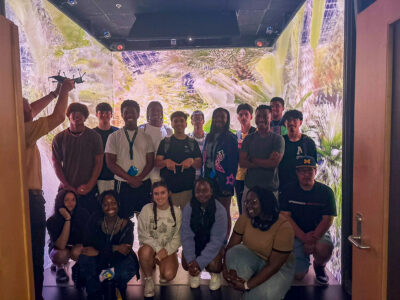
“Arduino boards are small computer boards that support data input, programmable data processing, and data output,” Hall said. “In general, this capability allows a creator to bring more sensory dimensions into a mixed-reality experience– not just sight and sound, but also tactile (wind), aroma, light, and heat.”
Within his project, Jenkins used Arduino boards and other technology to incorporate fans and lights within the MIDEN to react to a users’ digital location within the Botanical Gardens. By integrating this technology, users are placed directly into the Tropical House– feeling as if they can reach out to touch the leaves that surround the room. Jenkins even 3D designed and printed materials to make the experience more immersive.
“[This project] allowed me to see if I could render 3D scanned objects to create entire scanned worlds, opening up a whole new realm for gaming and architecture,” says Jenkins. “The MIDEN allows the exploration of situations that [elsewhere] would be expensive or impossible; and has advantages over other forms of media, like virtual reality or extended reality headsets.”
To begin his thesis project, Jenkins asked himself: “How can I create a physical experience in architecture without constructing the building itself?”
After seeing the finished product, Ted Hall answers, “People understand it as soon as they step in.”
Find more about the MIDEN on their website.
Photo Credits: Emma Powell
Article By Emma Powell